Day 322: How to Move to Taiwan During a Pandemic

Last night, I landed in Taiwan, which recently set a record of 200 days with no local coronavirus cases. While many countries are now struggling to contain a second wave, Taiwan is reaping the benefits of its early and swift response and can do things like safely host music festivals with thousands of people.
When I’ve talked to friends about coming here, almost everyone has been surprised to learn that there’s an easy way to enter the country despite the entry restrictions on foreign nationals.
Let me tell you about the Gold Card.
🌟 The Gold Card 🌟
The Gold Card is a special visa that the Taiwanese government created in 2018 to attract foreign talent to come live and work in Taiwan. It’s a “four-in-one” visa that bundles an open work permit, a resident visa, the Alien Resident Certificate (ARC), and a multiple entry permit.
What this means:
- You can live in Taiwan without being sponsored by an employer
- You can work for any company, including your own business
- You can bring your spouse and children with you, and your parents and grandparents can visit for up to a year
- You can re-enter Taiwan if you leave without applying for another visa
In other words, if you’re interested in living in Taiwan for a bit while working remotely for your current job, working for yourself, or finding a job after arriving, this is the perfect visa. If your application process goes smoothly, you can be here in about a month.
Eligibility
While there are several ways to qualify for the Gold Card, the easiest one by far is to meet the minimum salary requirement. You’ll qualify if you can prove that you’ve had a monthly salary of NT$160,000 (~$5,600 USD, equivalent to an annual salary of ~$67,000) at any point in the last three years. Since I spent the last several years traveling, making videos, meditating, and working on my own projects instead of making that ca$h money, I almost didn’t qualify, but thankfully my 2017 W-2 from Google saved the day.
For other ways to qualify, check out this FAQ.
Cost
The cost to apply depends on your nationality and the duration of your card (you can apply for 1, 2, or 3 years).
If you’re a U.S. citizen applying from abroad, here’s how much it costs:
- 1-year validity: NT$6,460 =~ $226 USD
- 2-year validity: NT$7,460 =~ $261 USD
- 3-year validity: NT$8,460 =~ $296 USD
Since the prices aren’t drastically different and the duration of your card doesn’t affect your application’s chances, you might as well apply for the longest one you can.
To look up costs for another nationalities, search for the “Online Payment” section on the official website.
Application Process
Step 1: Apply online
The application for the Gold Card is straightforward — it just asks for basic information, so you won’t have to write some 500-word essay about how you’re the perfect Gold Card candidate because you have an insatiable love for boba. If you have your documents (e.g. photo, passport, proof of income) handy, you can complete it in under 15 minutes.
What’s not so straightforward, however, is the website for the application. Simply finding the portal to start the application is already unreasonably difficult (it doesn’t show up on Google for “taiwan gold card application”) and the website can be pretty confusing.
To spare you needless pain, here’s a step-by-step guide for applying:
Toggle to view instructions
-
Navigate to https://coa.immigration.gov.tw/coa-frontend/four-in-one/entry/golden-card
-
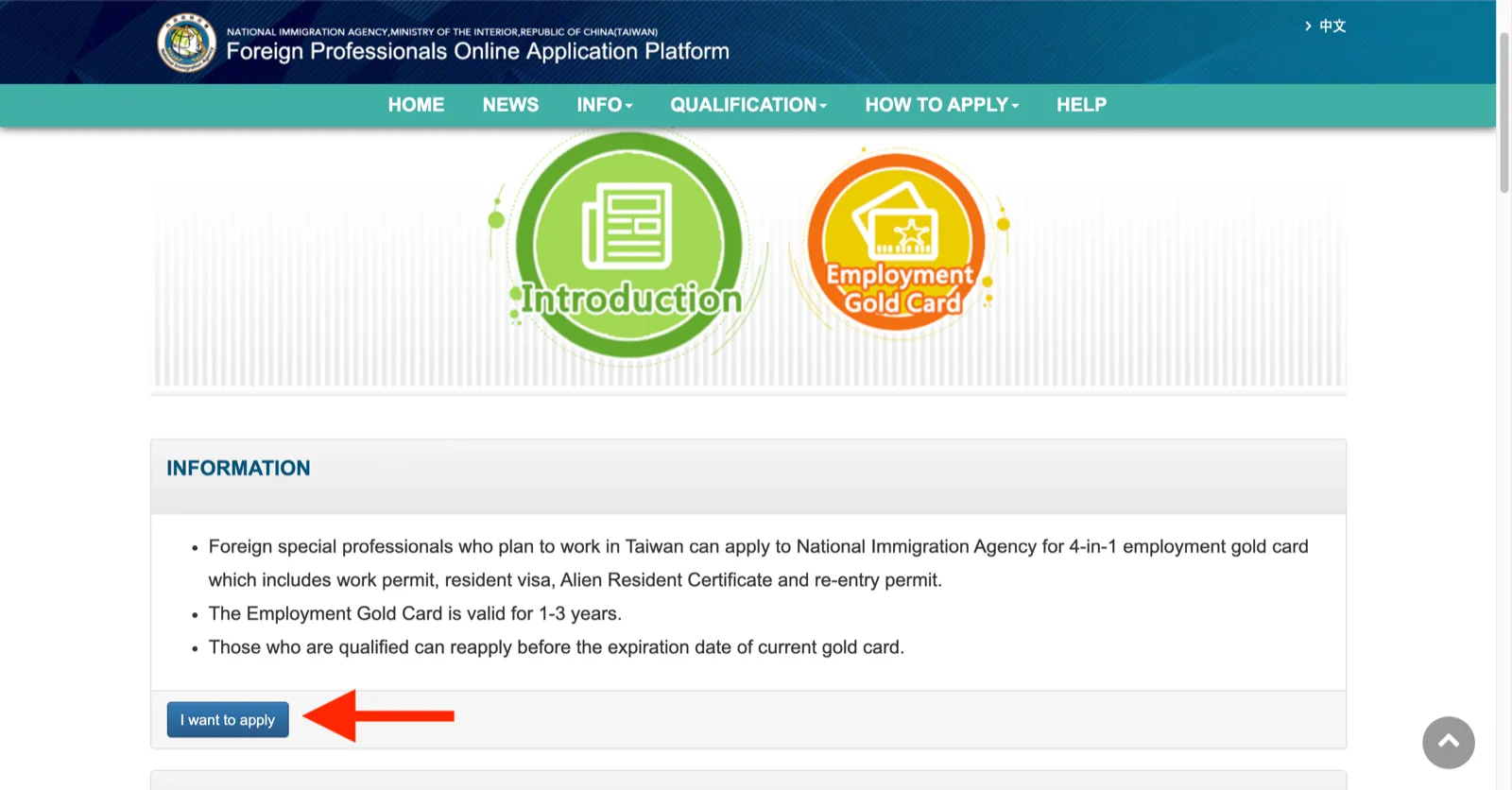
Click on one of the many, many “I want to apply” buttons on the page (they all do the same thing)
-
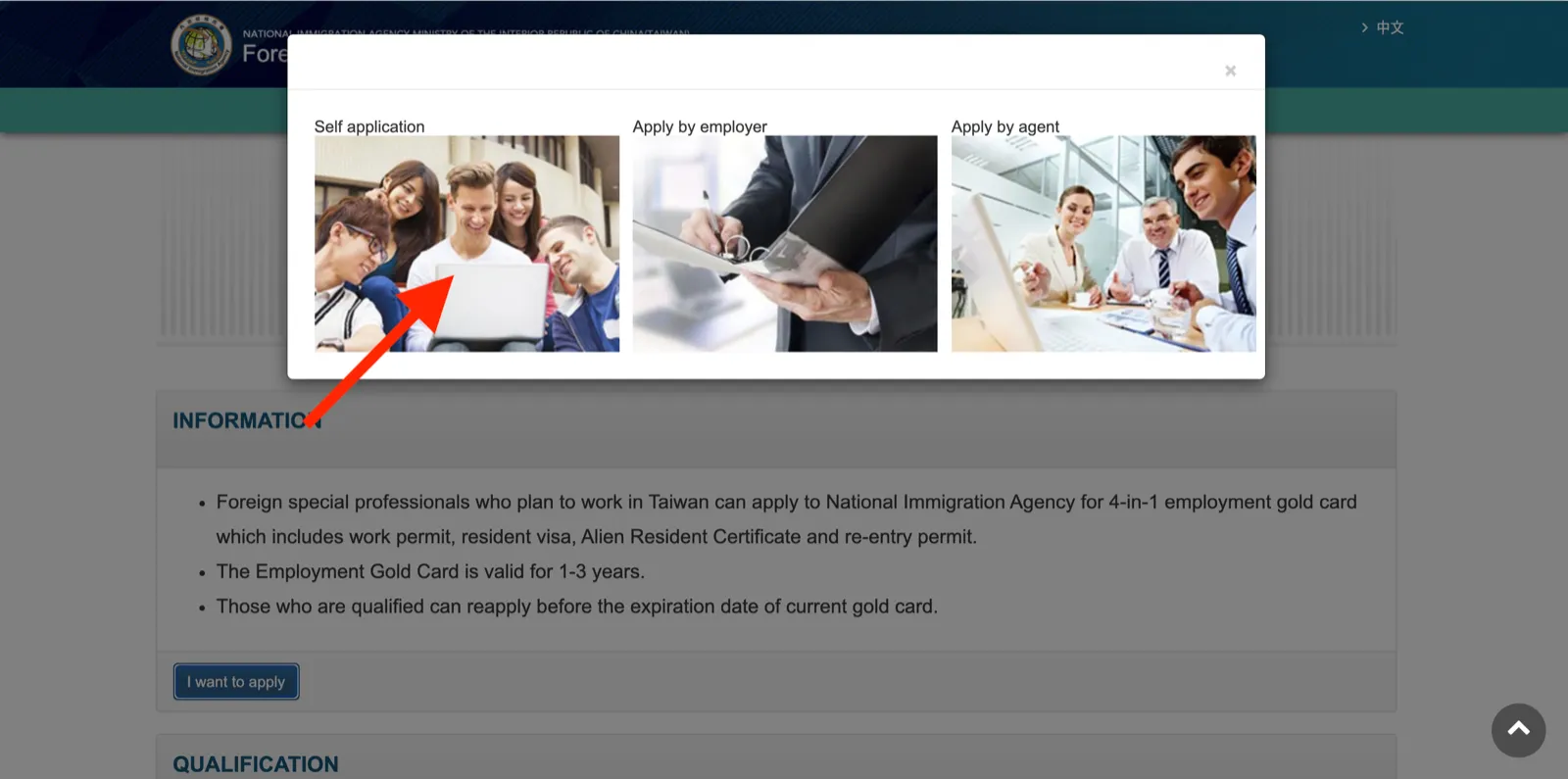
Click on “Self application”
-
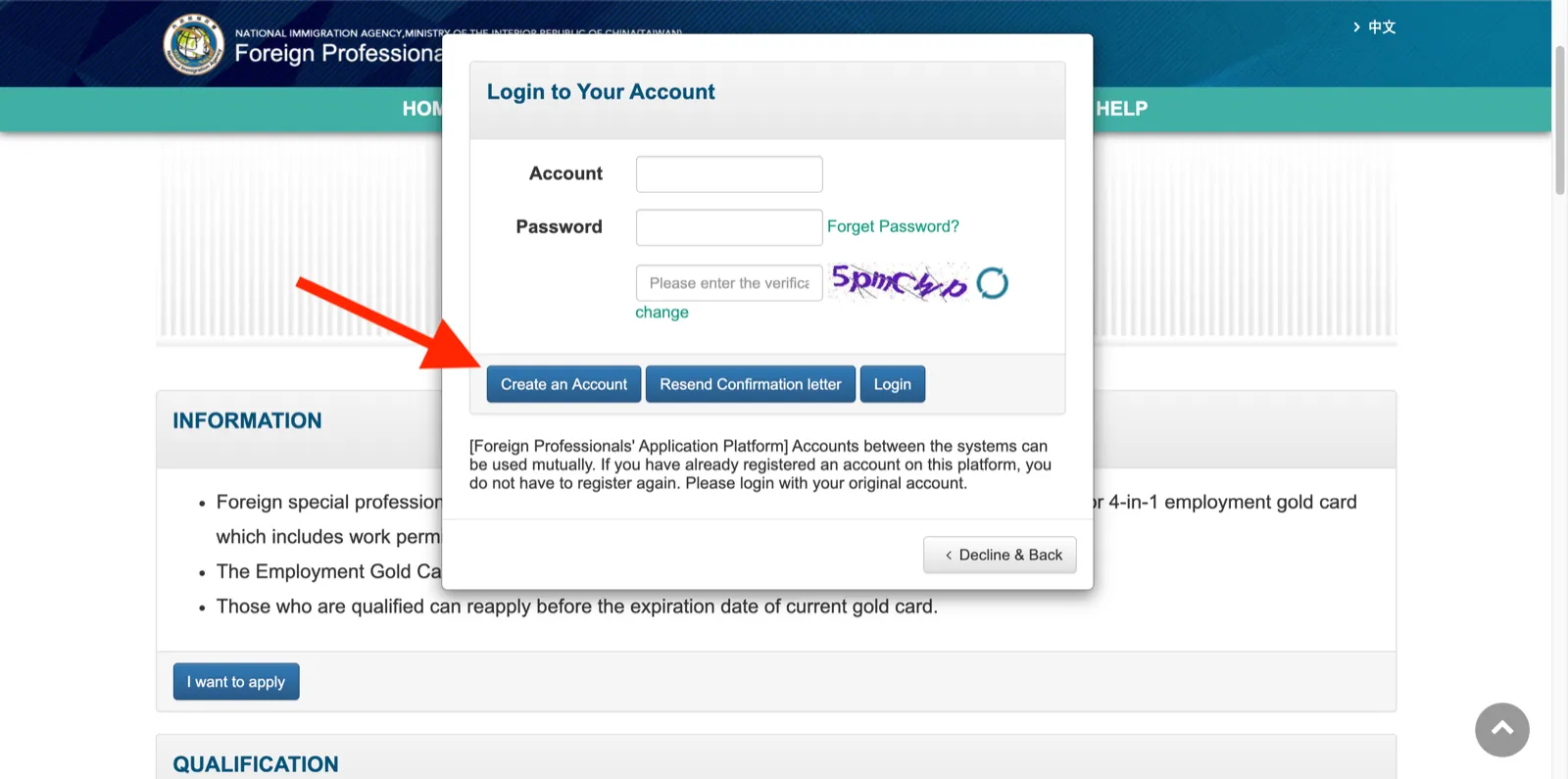
Create an account and log in
-
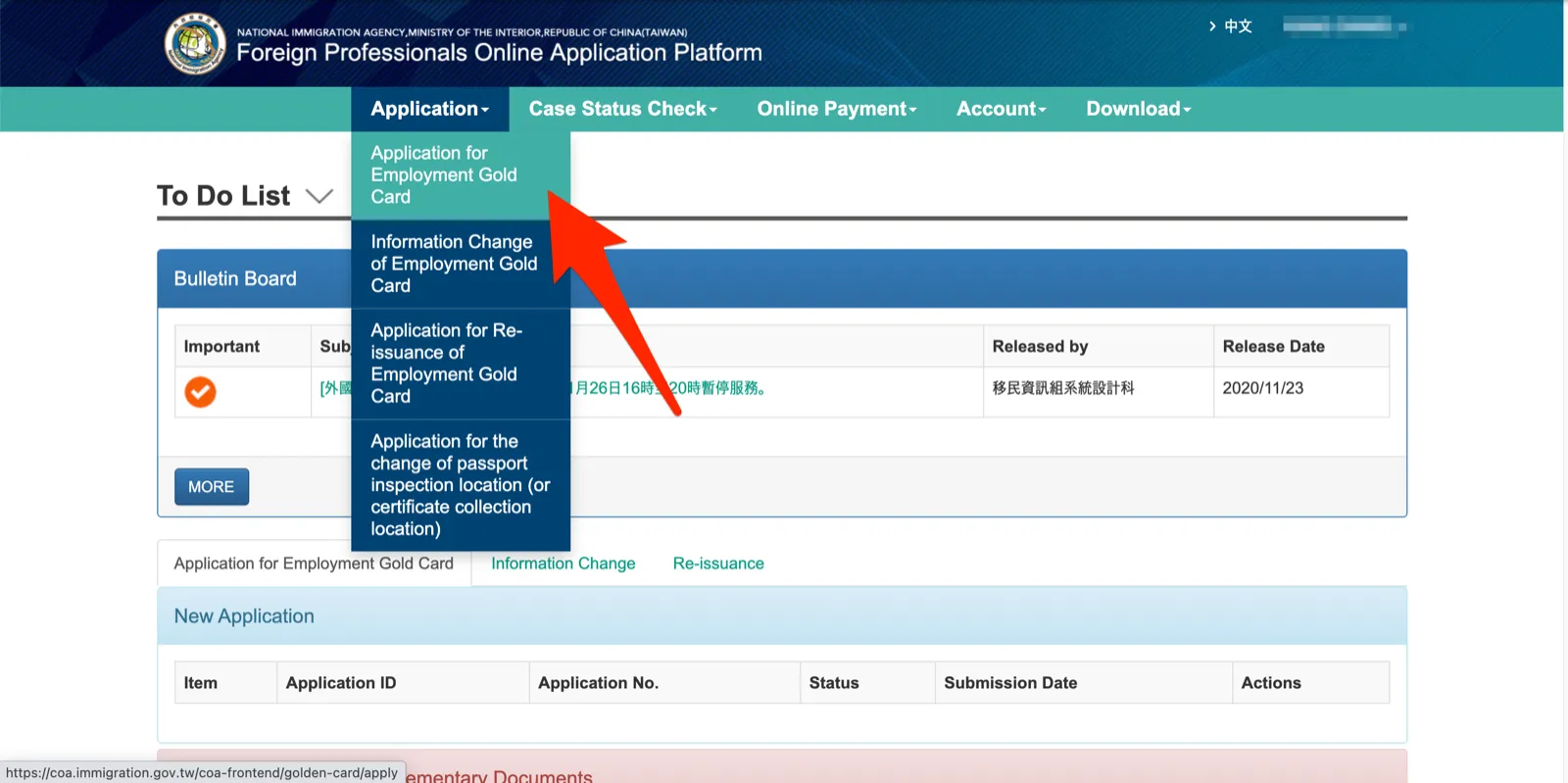
Hover over “Application” and click “Application for Employment Gold Card”
-
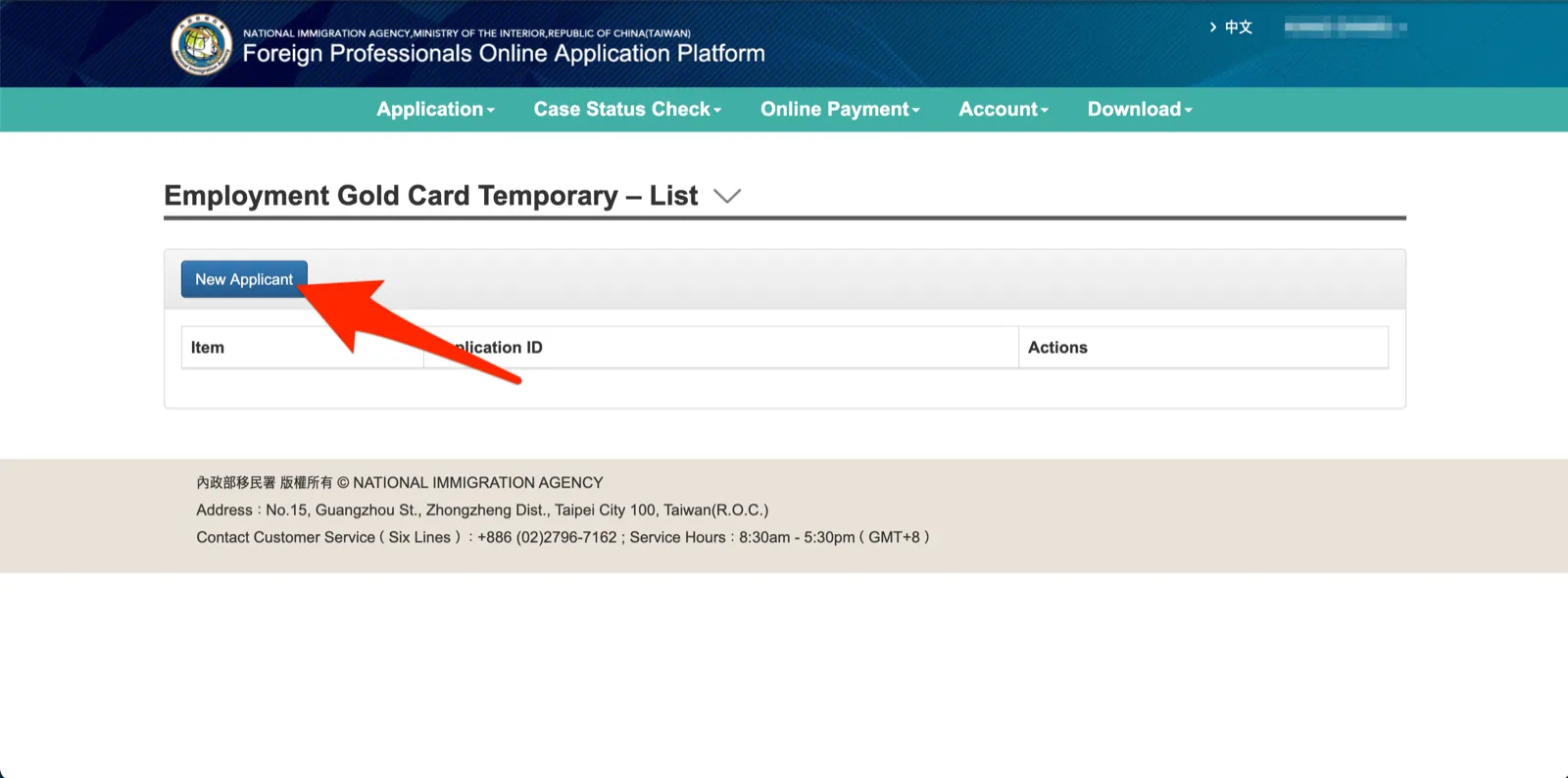
Click “New Applicant”
-
Fill out the application
-
Once you’ve submitted the application, you’ll receive an email from niasys@immigration.gov.tw asking you to submit your payment.
🔑 Key Tips
-
If you’re trying to go to Taiwan as soon as possible, select the option to pick up your Gold Card in Taiwan rather than at an overseas embassy
- Once your Gold Card is approved, you’ll get immediate access to a “Resident Authorization” document that allows you to fly to Taiwan. If you select the option to collect your Gold Card at an embassy, you’ll have to wait several weeks for the Gold Card to physically arrive (for me, it took a month).
-
If you’re applying using the NT$160,000 monthly salary qualification, select “Economic” as your profession
- Selecting another profession such as “Science and Technology” will require additional documentation to prove your technical skill (source)
-
For reference, here’s the application I submitted with personal information redacted:
Once you’ve submitted your application, you’ll wait for it to be reviewed, which takes several weeks. You may be asked for additional documents if there are issues with your application.
Step 2: Submit passport
Once your application has been reviewed, you’ll receive an email asking you to submit your passport. If the embassy you selected in your application is taking onsite visitors, take your passport there. Otherwise, mail in the following documents:
- Passport Submission Notice (downloaded from the application portal)
- Passport
- Prepaid return envelope with your address
Once the embassy receives your passport and verifies it, you’ll receive an email saying that your Gold Card was approved. The passport verification happens quite quickly (within a day or two of them receiving your passport).
🔑 Key Tips
-
Don’t forget to include the prepaid envelope! The instructions emailed to you don’t mention it, but it’s required for the embassy to send your passport back to you if you’re mailing it in.
- I purchased two USPS Priority Mail Flat Rate envelopes (one to send in my documents, one for the return envelope) for $7.75 each since they include USPS Tracking
-
If you elected to collect your Gold Card at the embassy rather than in Taiwan, make sure you won’t need your passport for about a month. While some people have their passports sent back to them immediately after verification, others (including me) had to wait until their Gold Card was issued and ready for pick up in order to get their passport back.
Step 3: Pick up Gold Card
Once your passport is verified and your Gold Card is approved, you’ll have access to the “Resident Authorization” document in the application portal that will allow you to enter Taiwan. Woohoo!
If you elected to collect your Gold Card in Taiwan, you can book your flight there and pick up your Gold Card at the National Immigration Agency once you arrive.
If you elected to collect your Gold Card at your local embassy, you’ll have to wait until your Gold Card is sent there in several weeks. When it arrives, you’ll receive an email telling you to schedule a time for you to come pick up your card.
If your local embassy is TECO San Francisco, they’ll tell you that you’ll be interviewed when you pick up your card. (From what I’ve read in forums, this seems to be unique to TECO SF.) At this point, your Gold Card is already issued so it’s not entirely clear what the point of this interview is. I was asked general questions about things like the kind of work I do, if I have friends in Taiwan, and when I plan to go. As long as you don’t start ranting about how China should invade Taiwan, you should be fine.
Congrats — you now have the ability to live and work in Taiwan, even during the pandemic!
My Timeline
For reference, here’s my timeline from starting my application to receiving my Gold Card:
- Submitted application and payment: 8/4/2020
- Review completed: 9/7/2020
- Submitted passport: 9/16/2020
- Gold Card approved: 9/18/2020
- Gold Card ready for pick up: 10/23/2020
- Interview: 10/29/2020
- Gold Card received: 10/31/2020
Come join!
One of the reasons why I came to Taiwan was because I missed meeting new people in real life and hanging out in physical spaces. If you end up coming (or if you’re already here), say hi! I’d love to meet up.
Resources
- Gold Card FAQ put together by a community of Gold Card holders
- Massive thread about the Gold Card