Day 357: How to Thrive in Quarantine
When people ask me how my time in quarantine when I entered Taiwan was, they’re almost always surprised when I tell them it was dope. Most people who’ve also gone through the two weeks of isolation talk about how bored they were or how they couldn’t wait to get out. I, on the other hand, had a hard time saying goodbye to my room at the end of my stay. I’d honestly be pretty stoked to go through quarantine again.
I’ll share how I made quarantine enjoyable for myself, but first, some background on why I found quarantining to be more pleasant than most people:
- I love meditation retreats and did a 3-month silent retreat two years ago. Compared to that, a two-week quarantine was easy peasy.
- I enjoy socializing and being with other people, but I also appreciate solitude and find stillness to be rejuvenating.
- Over the past several years, I’ve worked on removing the conditioning that makes us seek constant stimulation and dopamine hits from our phones and social media. I try to use my phone as infrequently as possible, have all my notifications disabled, and have built tools like Hide Likes, Hide Feed, and Intention to personalize my Web usage to support my well-being.
Mindset
When you think about being isolated in a hotel room all by yourself for two weeks, it’s easy to focus on the things you can’t do: You can’t meet up with friends. You can’t go out to places. You can’t change up your environment. And so on.
This is also what people initially focus on during meditation retreats. You can’t talk to people. You can’t text your friends. You can’t browse social media.
But the magic of these sorts of environments is the space created by the absence of all these things.
Rather than focus on the limitations of quarantine, I found it exciting to consider the unique opportunities now available. In quarantine, since your environment is fixed and you basically have no external stimuli, you have full control over how you spend your time and attention. That means:
-
You could reset and experiment with your sleep schedule
- What would you sleep quality change if you stuck to a regular sleep schedule? If you went to sleep earlier than normal? Later than normal?
- If you didn’t use an alarm clock, how long would you sleep for naturally?
-
You could reset and experiment with your diet
- How many calories do you need to feel satiated?
- What if you calculated how much to eat based on your basal metabolic rate rather than eating out of boredom?
- What if you tried intermittent fasting or a longer fasting period?
- In my case: What would happen if I lived off of powdered food (Huel) for 2 weeks? (Answer: Felt fine at the end of it.)
-
You have a socially acceptable excuse to turn down inbound requests and focus deeply on whatever you want
- I told everyone who wanted to schedule video calls during this period that I was intentionally not scheduling anything during my quarantine to focus deeply on my work. (Note: Since I’m an indie maker, I have full control over my schedule but this may be harder to pull off if you work on a team and have meetings, etc.) Some people were surprised as they thought I’d want more social interactions during quarantine, not less, but for me, I wanted to lean into the constraints and see how things would go.
-
You can run any other experiment you’d like
- What if you meditated as soon as you got up every morning?
- What if you didn’t touch your phone for an entire day? Multiple days?
If you can view the conditions of quarantine not as constraints that limit your freedom but rather as opportunities to try new things in a special environment, you’ll have a lot more fun. How often do you get the chance to completely design your lifestyle?
Routine
While I flirted with the idea of letting go of time entirely and seeing what kind of schedule I’d adopt if I didn’t keep track of time at all (my room also didn’t have any windows which would’ve helped this experiment), I decided to adopt a pretty regular schedule.
I made sure to focus on establishing the fundamental pillars of well-being: sleep, exercise, nutrition, and meditation. I set up a spreadsheet with activities I wanted to make sure I did every day and recorded the number of minutes spent doing it (the goal was to spend at least 1 minute on each activity):
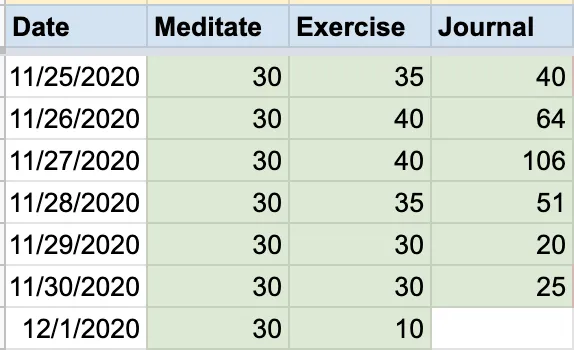
While my routine wasn’t perfect, especially near the end of quarantine, setting the intention to follow a routine made sure that I was regularly getting out of bed, washing up, exercising, meditating, journaling, and working every day instead of lounging about doing nothing.
Deep work
Lastly, it helps a ton to have something that you’re working on that’s aided by deep levels of focus. I worked on Browserflow, the automation platform I’ve been building for the past 7 months, and the work is interesting enough where I can get lost in it for days at a time. Having something that I enjoyed working on and thinking about made quarantine go by pretty quickly for me, and there are many activities that help toward this end: writing an essay, setting up a personal site, reading books, making videos, etc. Basically, any type of creative work that you can get lost in for long periods of time is ideal for taking advantage of the cocoon that you’re in during quarantine.
Some additional protips:
- Drink water!
- Wash up and take a shower every day even when there’s no need to make yourself look presentable — it helps psychologically to prepare for the day and make yourself clean
- Bring a yoga mat with you so that you can exercise using bodyweight workouts and yoga