Day 63: Social skills
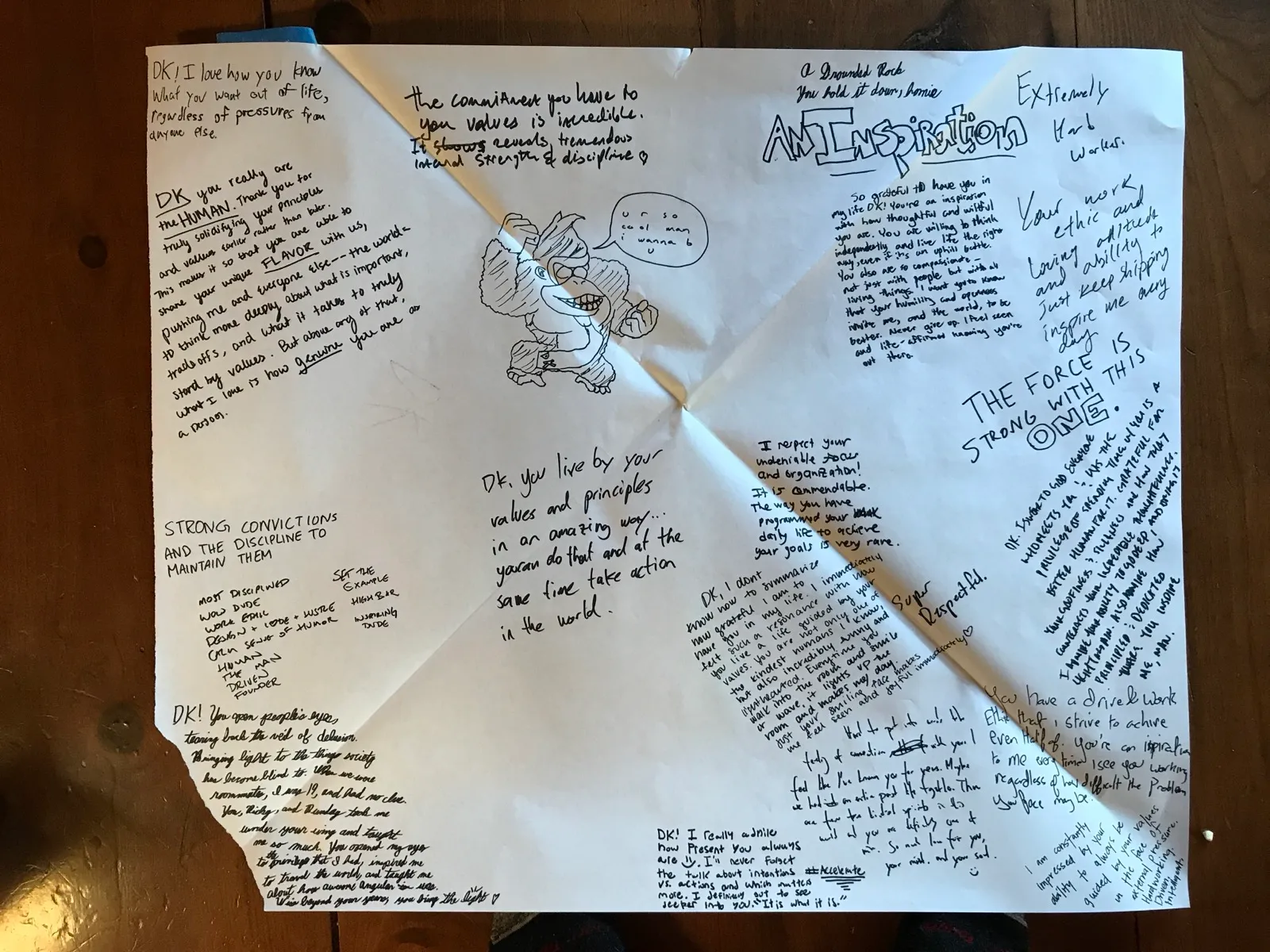
I spent this past weekend at an offsite in upstate New York for the Hacker Fellowship program. Most of it was unstructured time where we ate way too many Girl Scout cookies, asked each other personal questions in the hot tub, and learned how to make friendship bracelets (protip: only do this if you’re ready to commit the next two hours of your life). We had one organized activity which helped me reflect on myself and my relationships with others, and I wanted to share what I learned.
The activity involved everyone taking turns standing in front of a large sheet of paper while everyone else went up and wrote something positive about them. The person being written about wasn’t allowed to turn around to see who wrote what — at the very end, when everyone had had their turn, everyone received their poster to read.
You can see all the comments I received in the picture at the start of the post, and I saw two general themes:
- Commitment to my values
- My strong work ethic
Commitment to Values
For context, here are some areas where I differ from most of the fellows in the program:
- I want to bootstrap, not raise money
- I’m vegan
- I believe user privacy matters even if it’s inconvenient from a business standpoint
- I use my phone as little as possible and keep all my notifications turned off
Since we live together, eat together, and spend a lot of time discussing various topics, I often find myself presenting perspectives that differ from the status quo. I imagine this is why there were so many comments about my commitment to my values.
Work Ethic
Since the program’s start three weeks ago, I’ve continued spending a lot of time working on Hide Feed, Intention, and writing Road to Ramen. I have a lot of fun working because I enjoy building products and sharing them with the world. I’ve actually been surprised by how often I find myself working alone in our co-working space in the basement because I thought everyone else would be working quite a bit as well. I imagine some people are working in other places and that a lot of this might be due to me being at a different stage than most others — I came into the program already having projects I’m working on, whereas many people are still trying to form teams and come up with ideas. In the next few weeks, I’m hoping that I’ll have more company in the co-working space as people transition from ideation to execution.
It’s certainly nice to hear that people are inspired by my convictions and my discipline, but I also noticed what was largely absent from my sheet: positive qualities based on social interactions. I’m talking about things like being warm, kind, funny, charismatic, generous, leading effectively, etc. These are things that I care about — I subscribe to the belief that people remember how you make them feel more than anything, and I want to be a positive presence in people’s lives.
One of the reasons for this is that due to my focus on working, I’ve definitely spent less time socializing with other people in the program. It’d be great if that were the only reason why people haven’t been stunned by my radiant, incredible personality, but there’s unfortunately a much more compelling explanation: I have a lot of room to grow when it comes to personal interactions.
At the offsite, I had the opportunity to discuss the feedback I received and explore areas for growth with a group of friends that I trust, so I was able to learn more about my blind spots and get suggestions for ways to work on them.
For example, one of my closest friends shared that he feels like he’s bothering me whenever he wants to get my attention when working together in coffee shops. I completely understand why he feels that way — because I have a hard time context switching once I’m working deeply, I’m often in a mildly annoyed state when I get pulled away in the middle of a problem. One way that people who value deep work have solved this problem is to have people send a message first like “hey, can we chat once you’re free?” so that they can decide when to switch contexts, but that doesn’t work for me since all my notifications are disabled. As a result, people feel like they’re inconveniencing me when they want to interact, which is not great because I don’t want to make others feel like a burden.
Another friend shared that she felt intimidated when she first met me. I had apparently been working when someone came up and introduced me to her, and I don’t think I greeted her warmly because my mind was still with whatever I was working on.
The solution we discussed for both of these scenarios was the same: Be more explicit with my communication. For example, I can tell my friend when we work together that I’ll have both my headphones in when I’m focusing so that when I take them off, he’ll know that I’m open to socializing. (My ideal solution is to be able to set my notifications granularly so that I receive notifications from my friend and no one else while we’re working together, but alas, this isn’t possible today.) In the situation where I’m slow to switch contexts, I can explicitly say that I need a minute to go from problem-solving to socializing so that it’s clear to the people I’m with that I just need some time rather than not being happy to see them.
But not making people feel cruddy are table stakes; I want to make people feel appreciated and inspired. I want to improve how I interact with others so that if I were to do an exercise like this in the future, the words people associate with me are things like warm, funny, articulate, good storyteller, and charismatic. Somewhat related, I’d also like to be more proactive in planning activities with people and crafting experiences for everyone to have a good time.
There’s a part of me that feels like these goals around socializing are at odds with putting in the work to build a successful business, and taken to the extreme, they can be. But I also need to remember that relationships matter, too. I’ve been too extreme on the side of focused productivity, and it’s time to swing the pendulum back.