Day 27: Something or Nothing?
Today, I worked out of my local Starbucks and built support for being able to add as many custom photos as you want to integrate with Hide Feed. I’m really excited about this feature — I added a whole bunch of photos from my Google Photos and it was really fun seeing different parts of my life in the past several years every time I opened a site with a feed. I actually had a “omg this is dope” moment which isn’t something I experience every day because when you’re the one building your product, nothing really comes as a surprise because you’ve thought about it so much. It was really nice having that moment of magic where I was delighted by my own product.
This does present an interesting product design decision that I’ve touched on a bit over the last several days: What should take the place of the feed, if anything?
Nothing
A few days ago, my friend Sky sent me this text (saw it this morning because I sometimes go days without checking my messages):
Hide Feed is beautiful by the way. I’d love to test it out.
I read your most recent blog this morning. And it reminded me of Eleven in Tao Te Ching:
Thirty spokes share the wheel’s hub;
It is the center hole that makes it useful.
Shape the clay into a vessel;
It is the space within that makes it useful.
Cut doors and windows for a room;
It is the holes that make it useful.
Therefore profit comes from what is there;
Usefulness comes from what is not there.
The empty space that Hide Feed creates is why it is useful. To fill it with anything would actually decrease the user value for the product not increase it.
How beautiful is that! Also, love that I have friends like Sky who will just send me excerpts from the Tao Te Ching.
I agree with Sky that the usefulness of Hide Feed mainly comes from what it takes away. The main value of Hide Feed is that it shields you from all the distractions that are present in modern day websites. As I’ve talked about in some of my previous posts, companies have strong incentives to try to monopolize your attention and time. If you care about spending your time well, your interests are unfortunately quite at odds with theirs.
Several friends have commented that Hide Feed is like an ad blocker, and that feels apt. It’s a distraction-blocker that helps you get stuff done without getting sidetracked. So there is a lot of value in replacing the Default Something (feeds) with Nothing.
So now we have this empty space where the feed used to be. Would it be better to leave it empty? Or add something?
Something
The part about Hide Feed that gets me really excited is that there’s suddenly this massive potential to help guide people’s attention in beneficial ways. Take, for instance, the first Chrome extension I built back in 2011, Web Timer. Web Timer passively keeps track of how you spend your time online and shows the data with clean charts:
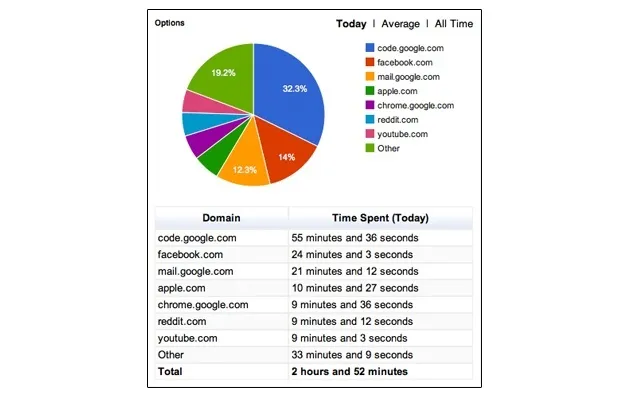
With zero marketing from my end, it gained over 70,000 users over several years and I ended up selling it in 2016 (and then reported it to Google to shut it down when I realized the new owners were doing sketchy things with it — a story for another time). Despite the fact that I made it, I pretty much never checked my stats for a simple reason: I never remembered to. Even though I cared about how I spent my time, checking the chart was an extra step that I had a hard time building a habit of checking.
Now imagine if Web Timer was integrated into Hide Feed. For people who want to be mindful of how they’re spending their time, they’d have to choice to be able to check on themselves every time they went to Facebook, YouTube, Twitter, etc. Instead of having to remember to check their stats, the information would be available automatically for their reflection.
This is where the idea of building a personal dashboard sounds really appealing. Hide Feed can be a way to help people follow through on their intentions through exposure. If your goal is to spend less time watching YouTube videos, maybe it can tell you how much time you’ve already spent on it that day and week. If your goal is to follow through on your tasks, maybe it can present a TODO list that you see whenever you open Twitter. And so on. You can choose what you think is best for you and have a surface that you’re bound to see multiple times a day.
I currently show photos, which is sort of in between nothing and something. It fills in the space with something interesting (and hopefully somewhat pleasing), but it’s cognitively light and doesn’t really try to direct your attention. Personal photos have the potential to draw you in more, and in my very limited trial period, it’s felt pretty positive. For example, one of the pictures that popped up was of a friend who I hadn’t talked to in quite a while, and I’m planning to message him after finishing up this post. I can see how revisiting memories through my personal photos might be really helpful for helping me nurture my relationships. (I’m honestly quite tempted to build a full-on integration with Google Photos so that Hide Feed can pull in photos without me having to download the photos and then add them manually, but I’ll give it some time before deciding to commit to that.)
The point is, I think that Hide Feed has the potential to help people use their attention in ways that makes their lives better. That’s why I’m leaning more towards having Something rather than Nothing, but it’s also something I’d like to think more deeply about. Someone at Starbucks asked me if he’d be able to have his RSS feeds take over the space created by Hide Feed, and I laughed — replacing feeds with your own feed sort of defeats the whole point. I think I have notions around what’s valuable and worthwhile to put in a personal dashboard and what wouldn’t be. For example, having something like Web Timer for reflecting on your browsing habits seems worthwhile whereas having a Bitcoin price tracker or a stock ticker seems like yet another form of mindless distraction. There’s definitely a lot of gray area here though.