Day 98: Making Intention Social
Intention’s groups feature isn’t working. I mean, it works in a technical sense, but the feature just isn’t compelling. Here’s how it’s currently designed: After a group has two or more members, a group streak is started. The group streak is reset when someone goes over the limit that they’ve set for themselves. Here’s what the feature looks like:
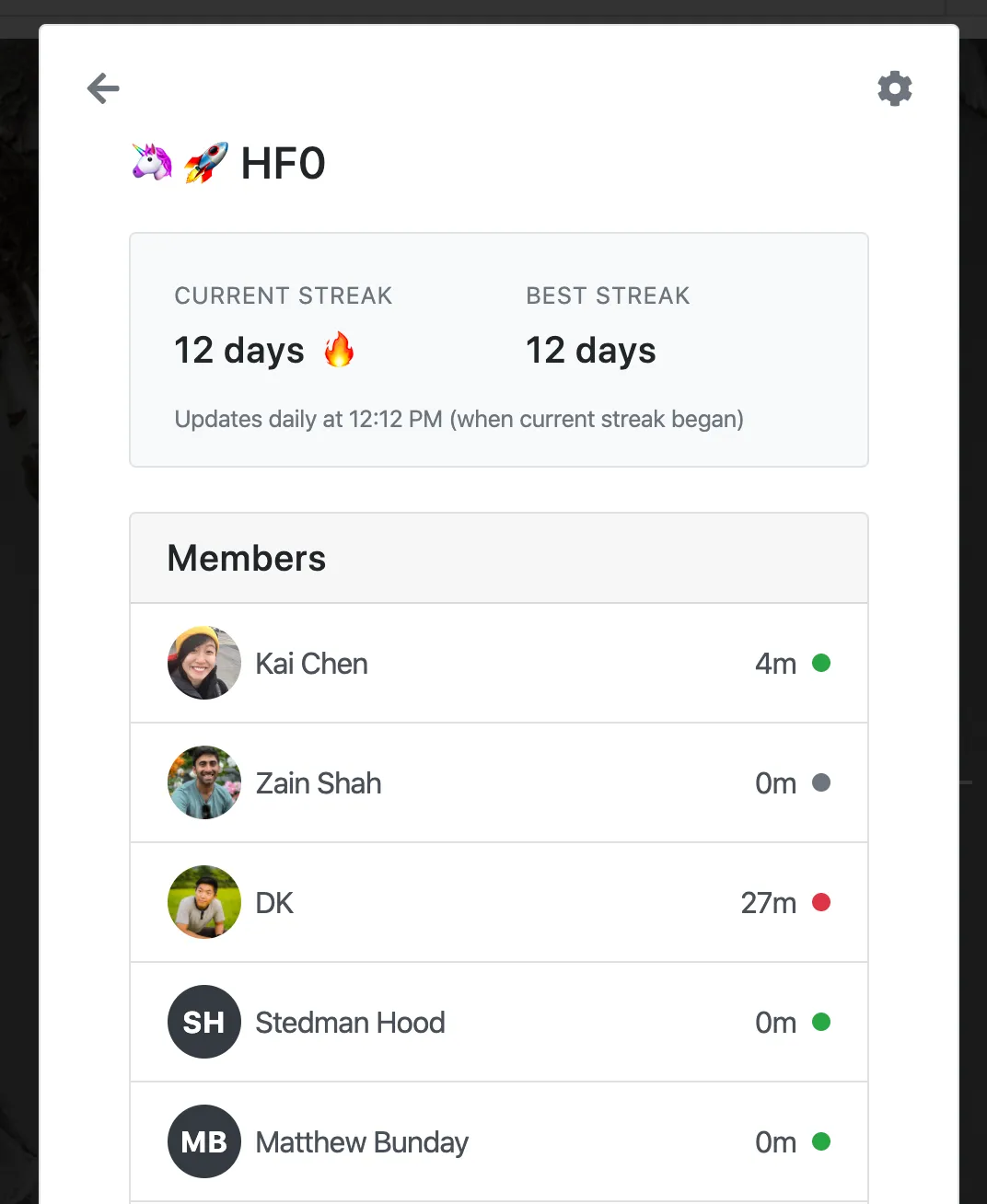
I made the groups feature thinking that it’d introduce social accountability, and while it does do that to an extent, it’s just not that compelling of a feature. I’m quite glad that I hid the feature under a secret flag so that I can completely rework it without worrying about upsetting users because all of the people using it right now are my friends.
Let’s go back to the beginning. What am I trying to accomplish with a social feature within Intention?
Perhaps we should go up the stack even more: What is the goal of Intention?
Intention’s mission is to help people spend their time well. Many people feel guilty or embarrassed by the amount of time that they spend on social media and entertainment, and it’s crucial to recognize that they’re not wholly responsible: Today’s services are geared to suck people in and capture their attention for as long as possible. With Intention, I’m hoping that people can live their lives that’s in congruence with their deepest intentions.
Great. The interventions and the time limit are quite effective at helping people be more mindful of how they’re spending their time and attention. How would adding a social feature help?
There’s a lot of power in social accountability. Working out is a great example of this: It’s much easier to build a habit of working out when you’re surrounded by people who push you (e.g. a gym buddy) and people who recognize and appreciate your accomplishments. Our browsing is often done in private, in the warm cradle of our bedrooms and on our handheld devices — would social accountability help deter someone from binging a bunch of YouTube videos or scrolling through random subreddits at 2AM?
What I learned from the existing groups feature is that —
One second. In the middle of writing the above sentence, I switched over to Chrome, opened Facebook, saw that I was at 27m out of my 30m limit, closed the tab, and came back. Intention works! Hell yeah.
Anyway, now that I’ve broken my arm patting myself on the back, back to the social feature.
There seem to be two major questions to answer:
- What data is shared?
- How is the data shared?
What data is shared?
What I learned from the existing groups feature is that I need to think more deeply about how the data that’s shared affects the experience. Right now, the data that’s shared is
- How much time someone has spent on distracting websites
- What their limit is
The rub is that the metric being shared, how much time being distracted, is decidedly negative. The bigger this number gets, the worse you feel about sharing it and having others know about it. Contrast that to every other social platform that emphasizes something you can be proud of: Number of upvotes, number of likes, miles run/biked/swam, pounds lost, etc.
How can I change the metric shared to a positive thing?
The following metrics don’t qualify:
- Time spent on distracting websites (today, this week, etc.)
- % used of daily limit (includes simple green/yellow/red color indicators as well)
A suggestion that Zain made was to compute a productivity score based on (1) total time spent on their computer and (2) the time they spent on distracting websites. For example, someone who spent 10 hours on their computer and 1 of those hours on distracting websites would have a productivity score of 90%.
This approach has some drawbacks (e.g. someone might spend hours on Netflix but if it’s not part of their distracting websites, it’d count as “productive time”; this encourages people to spend more time on their computer; someone who only uses their computer for 1 minute would have a productivity score of 100%), but I do like that this is a positive metric. Maybe this would encourage people to add more sites to their distracting sites to make it accurate? Or maybe drive the opposite behavior so that they look like they’re productive more than they actually are?
Putting this exploration on hold.
How is the data shared?
There are two choices here: cooperative or competitive.
Groups uses a cooperative mechanism — group streaks — which encourages everyone to work together for the betterment of the group.
A competitive way of sharing the data would be something like a leaderboard, where people compete along some dimension.
The competitive approach might be more motivating and fun for people.
Oof, I’m feeling quite sleepy writing this, and this is a reminder that I should try to write these posts in the morning, not at night. I’m having trouble thinking clearly now, and I’m now I’m second-guessing whether the positive metric vs. negative metric thing makes sense. Okay, this is a bit of an abrupt stop, but I’m going to bed!