Day 45: Should I include analytics?
I’m having a hard time deciding where to draw the line in terms of adding analytics into my products.
Let’s take Hide Feed as an example. Currently, I don’t include any analytics, so the only things I know about my users is what I see in the Chrome Web Store:
- Daily installs
- Daily uninstalls
- Daily impressions
- Weekly users
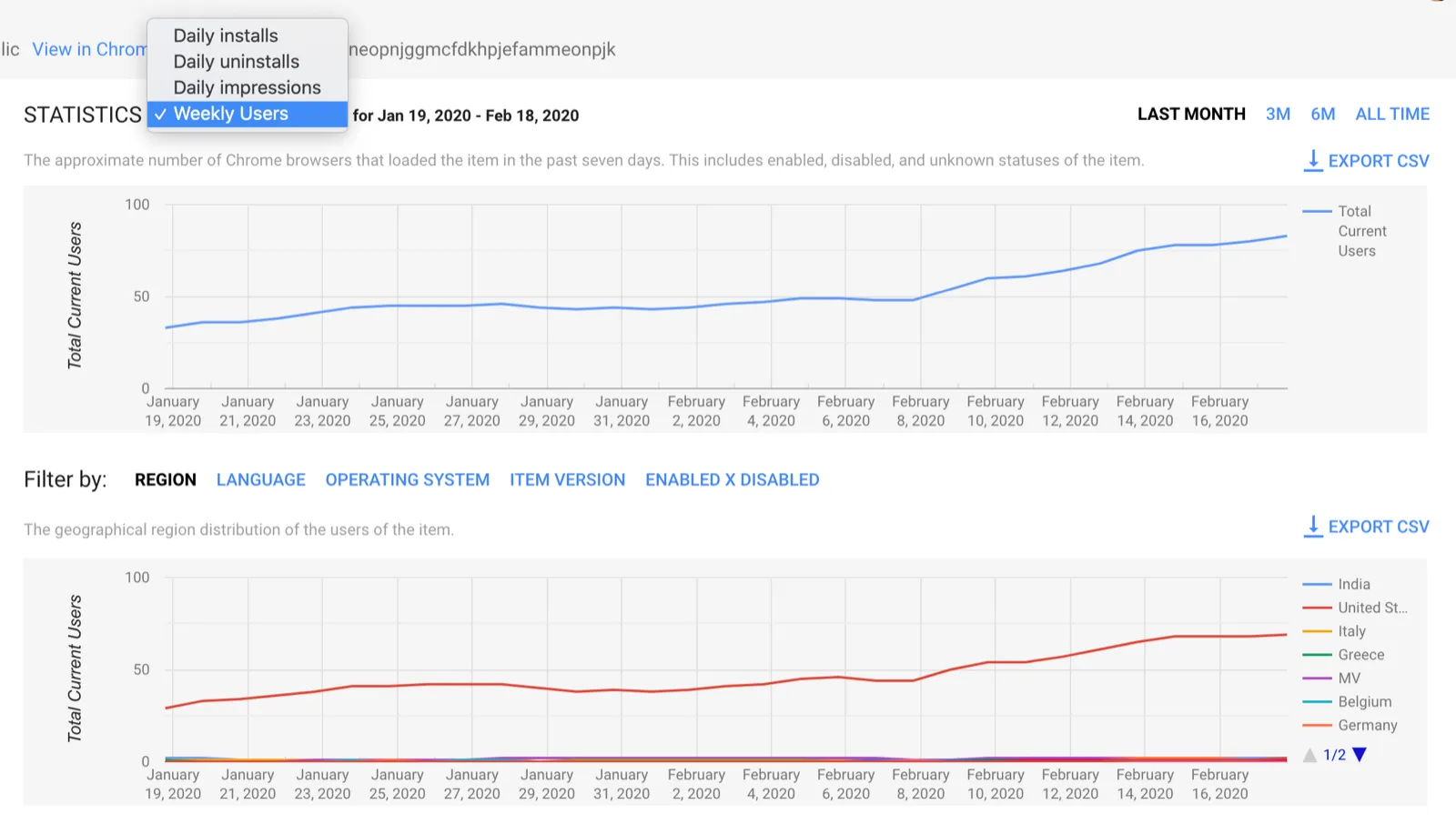
I don’t know how Chrome defines “Current Users”, so it could be people who just have my extension installed or people who have it enabled. It’s unclear how many people are actually using Hide Feed.
Beyond that, I have no idea how people are using it. Here are the types of questions I’d like to be able to answer:
- Time saved: How much time does Hide Feed save people on a daily basis? (Estimated based off the number of times feeds are hidden.)
- Image type usage: What percentage of people use themed images from Unsplash as their feed replacement vs. custom images?
- Site usage: Which sites do people hide feeds on?
Let’s think through why I’d like to know these questions:
-
Time saved
- Marketing: “Hide Feed saves users an average of X hours per day!” would be useful to have on the landing page
- Personal gratification: It’d make me feel good about the work I’m doing (“yay, I’m helping people!”)
-
Image type usage
- Feature management: Contrary to many tools, I try to limit the number of features in my products as much as possible. It reduces maintainability costs (helps to make sure I’m doing a few things well instead of a lot of things poorly) and also simplifies the product (makes it easier to use). If no one wanted to used custom images, I’d prefer to get rid of the feature.
- Sales: I have a hypothesis that custom images, once used, could make Hide Feed a lot more valuable for people and thus worth paying for. It’s really nice to see friends and loved ones randomly throughout the day as you’re browsing the Web. If I knew that people valued Hide Feed more from using the custom images feature, I’d spend more time bringing attention to it in-product and making it easier to use.
-
Site usage
- Feature management: If I found that only 1% of users enabled Hide Feed on Reddit, it’d make it much easier to decide to stop supporting the site if Reddit made a massive change to their site and Hide Feed required significant changes to work on Reddit again.
These reasons seem pretty defensible, but adding analytics into my product feels like a slippery slope. From working at various tech companies, I know that once you have the infrastructure in place, it’s really easy to justify tracking whatever you want because it’s just one additional line of code. And once you start going down that rabbit hole, you start tracking all sorts of things, even if you don’t have a good reason for doing it, simply because you can or you thought it’d be a fun tidbit to know. Eventually, you end up with a nightmare-of-a-product like FullStory where you can simulate looking over the shoulder of your users by recording every little action they perform. The scary part is that many people will read the previous sentence and think “What’s wrong with FullStory?” I’ll dedicate a separate post to discussing the dystopia we’re creating by stripping everyone of their privacy online.
It’s a lot easier to show users that you truly value their privacy if you can make a strong statement like “there is absolutely zero tracking or analytics code in this product”. Many companies claim to put my privacy first, but I’m skeptical whenever I read that because I know that their standards and mine are likely completely different. A Chrome extension I used with Gmail claimed to respect my privacy, but they were also scraping my Gmail and uploading my email address, full name, and usage behavior to Mixpanel. Not cool. Sadly, this is now the norm in tech, and I don’t want to copy these practices uncritically and justify them with “well, everyone else is doing it.”
There’s an inherent tension between user privacy and getting insight into user behavior. I don’t want to make the decision of adding analytics lightly because I want to create products that I’m proud of, and part of that is giving people the power to control what information they share. Perhaps including analytics would be fine if there was a very easy way to opt-out or you had to opt-in to enable analytics. If few people opted-in though, it might be more misleading than helpful by making decisions off of skewed data from a small group of self-selecting people. At that point, I might as well just not include analytics.
It’s hard to get advice about this topic from most of my peers as well because I don’t know what their values are or how they think of privacy. It can sometimes feel like I’m at a BBQ convention asking people whether I should become vegan or not.
One thing I appreciate about writing publicly about my journey through Road to Ramen is that it provides accountability — it’s forces me to stay honest with myself and deeply think through my decisions, especially when there’s a lot of gray area like in privacy.
I still feel fairly conflicted about whether or not to include analytics and if so, how to go about it in a way that truly respects users, so I’ll continue thinking through it and sharing my thoughts publicly.