Day 312: Unlearning Helplessness
Last year, I purchased my first car: a used 2007 Honda Civic with 145,000 miles. I wasn’t sure how long I’d be in Austin or how long I’d want to own a car, so I wanted something cheap that’d be both reliable and easy to sell if needed.
Since I knew nothing about cars and had never purchased one before, I committed the cardinal sin of not getting it inspected before purchasing. For such an old car, I was asking for trouble — and trouble I got.
A few weeks after the purchase, I was driving home one day when the music streaming from my phone randomly cut out for a few seconds before resuming. Weird. When it happened again, I realized it wasn’t just the audio system that was acting strange — the entire electrical system for the car was turning off and on while the car was in motion. Terror. Was this a power failure? Would the car stall in the middle of traffic? Would the steering wheel or the brakes stop working? I switched to the rightmost lane and drove slowly to prepare for any surprises. The power reset every minute or so for the rest of the ride home, but thankfully, the car drove fine.
Starting to suspect that perhaps this 13-year-old car might have some issues, I set up an appointment at the local Honda dealership and got it inspected. Of course, there was a fat list of critical concerns to be addressed:
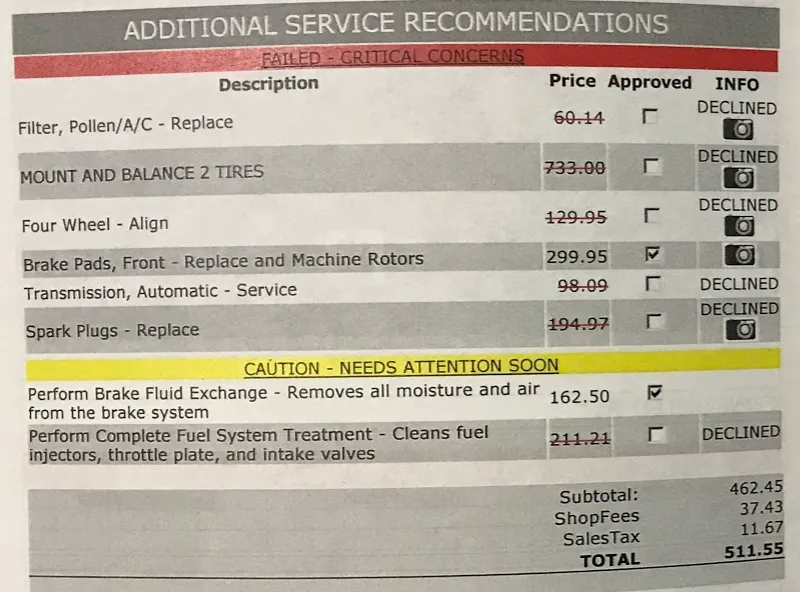
The problem was that I had no idea what any of this meant. Okay, I knew what brake pads were. (But rotors?) Transmission? (What did that do again?) Spark plugs?
The cost for getting everything fixed would be almost $2,000. I could afford it, but I didn’t buy a cheap car so I can pay 40% of the purchase price immediately on repairs. But what else could I do? I didn’t want the car to break down in the middle of the road. I was bummed out.
Thankfully, the rep who was helping me was super nice. Given how young I look and that I had brought in a beat up 2007 Civic, I wouldn’t be surprised if he thought I was a broke college student. Instead of pushing me to pay for all the services, he started telling me about how I could fix some of these things myself. He pointed at the first line and said that all I needed to do was order an air filter online and that I could easily replace it myself.
Huh. A switch flipped in my mind, and I realized that there was an alternative to me being a clueless schmuck who paid the dealership to fix everything. I could look into fixing things myself.
I had initially agreed to get the brake pads and brake fluid changed during that visit, and when the rep left to get the full estimate, I furiously googled each of the services. There were guides and YouTube videos for everything. The idea of replacing the brakes on my car seemed unfathomable because I was sure that I’d mess it up and kill myself, but all the resources online said that it was actually fairly easy to do. Huh.
I decided to give it a shot and left that dealership without getting anything done. Turns out that the Internet was right. Over the next several months, I learned how to replace air filters, rotate tires, install new spark plugs, change brake pads and rotors, replace brake fluid, install batteries, and restore headlights. What’s funny is that people’s reactions to that last sentence will be quite different depending on their level of experience working with cars: computer-dwellers like me who have never opened the hood of their car will think that I’m basically a mechanic now; people who actually know a thing or two about cars will laugh because the tasks I listed are super basic. And that gets at the heart of the lesson I learned: Many things that seem impossible are actually quite easy if you overcome the mental hurdles that stop you from just doing it.
I’m recalling this experience because I’m once again unlearning helplessness in my current mission to fix things around my house. I’ve noticed that when faced with a task in a domain I’m unfamiliar with, my default response is to think “I don’t know how to do that” and accept that at face value. Instead of trying to fix things myself, my inclination is to look for someone who can solve the problem for me.
When I put together a list of things to fix around the house, I figured that I’d be able to do the ones that didn’t require special skills (e.g. cleaning) but that I’d need to call a professional to handle things like fixing the toilet or getting the garage opener to work. I’ve been delighted to discover that I was wrong.
It turns out that to fix a toilet, you don’t need to be an expert on plumbing, and that a $10 part from Home Depot will fix most common problems. The hardest part is not actually the fixing, but facing the fear of the unknown. Before looking into fixing the toilet, I had a distorted perception of the risks involved. Will I accidentally flood the entire bathroom? When left unchecked, fears like that stopped me from looking further and made me give up before I’ve even tried. But when I dig deep and learn more, I often find that my fears have no basis. Oh, toilets have shutoff valves that stop the flow of incoming water. And in the case of fixing my garage door opener: Will I accidentally electrocute myself? Oh, unplugging the garage door opener when working on the wiring eliminates the possibility of shock. Duh. The fears evaporate.
The best part about the process of unlearning helplessness is that each victory begets confidence which leads to bigger victories. The feeling of “wow, that was way easier than I thought it’d be” makes you think that maybe the next big thing won’t be so bad either. I started off by changing a lightbulb in the bathroom and in just a few days, found myself cutting metal with a hacksaw to construct a frame for a window screen and using a multimeter to check for bad wires. Both of those tools intimidated me before, but all I had to do was watch a 5-minute YouTube video.
The benefit of defaulting to tackling problems yourself is not that you’ll fix everything you come across: I needed a mechanic to look into a leak in the power steering in the Civic, and I might have to call a plumber because I can’t loosen the nut on my faucet handle no matter what I try. The benefit of unlearning helplessness is that you grow to trust yourself and your own ability to figure things out. Problems that arise unexpectedly aren’t as stressful when you operate with the baseline assumption that you’ll figure it out. And if you do call in outside help, it’ll be due to an educated assessment of the situation rather than a knee-jerk reaction based on feeling helpless. And by attempting things yourself, you’ll not only save a lot of time and money but also learn a good deal about how everything works.
I’m sure that I’ll have to relearn this lesson many more times in many more domains. But I’m hopeful that over time, as my trust in myself grows, my default response to unknown challenges won’t be “I can’t do this” but rather “how can I do this?”