Day 281: Charging for a Private Beta
If you go to Browserflow’s website, all you get today is a link to join the waitlist:
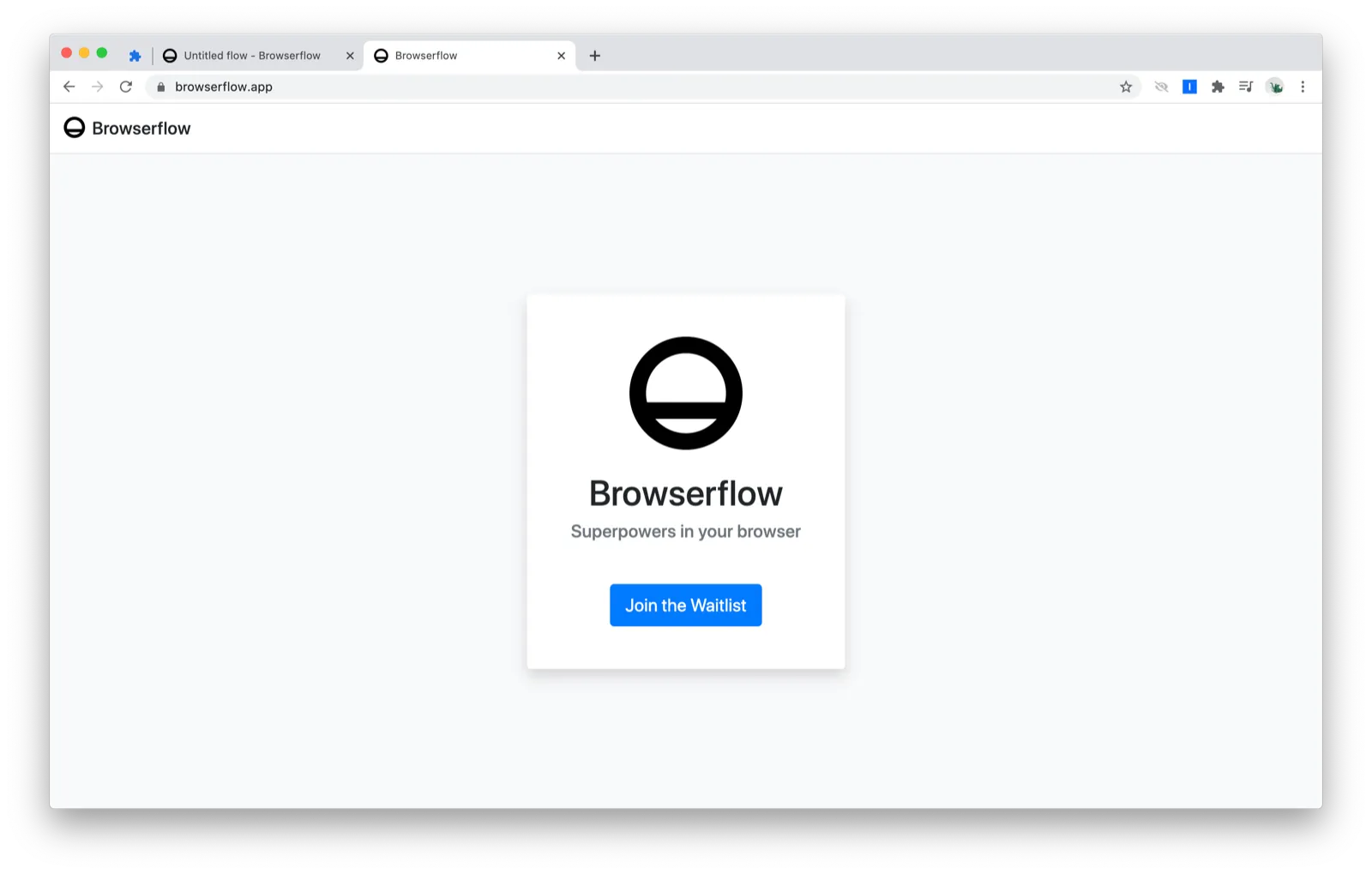
Thanks to some of the demos that I and others have shared on Twiitter (1, 2, 3, 4, 5), I’ve already had 68 people sign up despite there being nothing on the website. Unfortunately, their emails have just sat there collecting dust in a Google Sheet because I’ve been focused on making the product more versatile and stable rather than trying to onboard people.
I can’t believe it’s been four months since my initial demo — even though Browserflow’s progressed a lot since then, it feels like I’ve waited perhaps a tad too long to share Browserflow with more people. But then again, I also felt like I was receiving just the right amount of feedback (vs. being overwhelmed by requests), so maybe sharing it with a tiny group of friends rather than a larger set of beta users was actually fine. Impossible to tell with these kinds of situations.
Anyway, now that Browserflow is powerful and stable enough where it can support a wide variety of sites and use cases, I’m going to start sharing it more. To start with, I’m creating a gallery with pre-made flows you can import with a single click. I imagine there will be people who want to get access to Browserflow just to use one of the example flows (this was the case with the Roam flow that I shared — most people just wanted to use that and didn’t have ideas for things they’d want to build themselves).
Unlike Hide Likes, Hide Feed, Intention, and basically every other product I’ve created in the past, I want to be thoughtful about the users I initially get feedback from. Since the product is still quite young, the feedback I receive and act on now will have a large impact in shaping the direction of Browserflow. As a result, I’d rather get great feedback from 5 people than mediocre feedback from 50 people.
In order to limit my initial set of users, I’m going to try something I’d never considered before: charge people for beta access.
I got this idea from learning about how Zapier grew in its early days. Here’s a quote from a 2015 interview with Wade Foster, the CEO of Zapier:
For a tech beta, most companies just say “sign up, it’s free, all you have to do is give us advice… we’ll take anyone’s advice.”
They just beg for customers.
We made people pay a one-time fee to get into our beta.
For the first few people, we charged $100 for access to the beta for as long as the beta lasts.
And that number moved around; we charged as little as $1, and eventually it settled in around $5 or $10 to get into the beta towards the end.
It’s not that we wanted to make money off of the beta, it’s that we wanted people who really thought this was important enough to pay for and spend some time with us for. The last thing we wanted was a bunch of tire kickers who are just trying it out for fun but had no plans to use it on an ongoing basis.
So that little hurdle of just paying a little bit of money got us some really high quality early users who went above and beyond in terms of providing feedback to us on the things that mattered.
I’m going to start by charging $20 because that feels high enough where it’ll deter people who just want to try it but aren’t really that interested but low enough it’s not prohibitively expensive. Since I want to make sure that I’m able to provide adequate support for everyone who signs up, I’ll likely bump up the price if I find there are a lot of people who want to join the paid beta.
And if no one wants to pay to join the beta, then I’ll have some serious reckoning to do. 😅